Agents work your backlog. You approve every plan.
Camelot runs Claude Code and Codex on your GitHub issues, each in its own container. The agent posts a plan on the issue, and nothing is written until you approve it. Runs are scheduled around your weekly usage limit.
Bring your own Claude or Codex credential · Encrypted at rest · Open source (GPL-2.0)
Built for three problems you already have
Your agent wrote 2,000 lines, and now you have to read them.
The agent writes a plan first. You review a page of intent, not a wall of diff. Ask for changes in a comment, or approve and let it build.
You hit your weekly limit on Wednesday.
Keep part of each week's quota for your own work, run agents only in the hours you choose, and give urgent cards a deadline. When a provider says "limit reached", the task pauses and resumes later. It doesn't fail.
You can't see what the agent is doing.
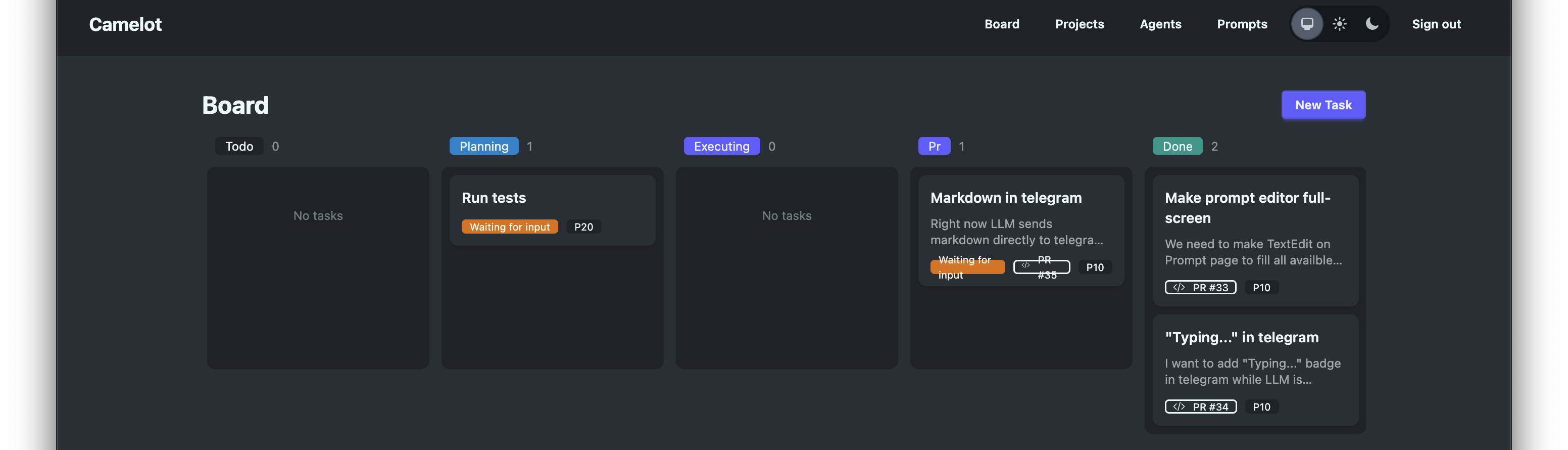
Every task is a card with live logs, its own container, and a PR at the end. Nothing merges until you approve it.
How it works — right inside GitHub
No new tracker. Label an issue and review the plan where you already work. The board is there when you want the overview.
-
Add the
camelotlabel to an issue. Optional labels:camelot:agent:<name>,camelot:model:<id>,camelot:skip-plan. - The agent reads your repo and posts its plan as a comment.
- Reply
/approveor react 👍. Or comment what to change, and it revises the plan. - The agent works in an isolated container and opens a pull request.
- You review and merge. Camelot posts a summary and closes the issue.
Only project members can trigger or approve work. Comments from anyone else are ignored.
Spend your quota on purpose
Set a weekly reserve, for example "agents may use up to 80% of my Claude week". Choose run windows, like nights and weekends. Pin a card to a start time or a finish-by deadline. Cards show why they're waiting, and urgent ones move to the front.
Claude Code usage is read automatically after each run. For other agents, you enter your current usage by hand.
Safe by default
- Plan approval before any code is written
- PR approval before anything merges
- One fresh container per agent run, never your laptop
- Weekly cap and run windows, so there are no runaway bills
- Pause on usage limits, with no retry loops
- GitHub triggers accepted only from project members
Built with Camelot
51 of the 180 pull requests merged into Camelot since May 2026 were written by Camelot's own agents and reviewed by a human.
See them on GitHub →as of Oct 22, 2026
Works with the agents you already pay for
- Claude Code — fully supported. Paste an Anthropic API key or a Claude Code OAuth token (
claude setup-token). - Codex — supported. Paste an OpenAI API key.
- More coming: Antigravity and Kimi Code CLI is on the roadmap.
Run anywhere, your way
Self-hosted
Run it on your own servers. Your code and credentials never leave your network. Free forever.
Cloud
Sign up and start in minutes. Agent runs happen in isolated containers we manage. Free during public beta.
Public beta is open
No waitlist, no application. Cloud is free during beta, and founding members lock in a free year. Self-hosting is always free.
- Direct line to the team — Telegram group + weekly office hours
- Shape the roadmap: your feedback sets what we build next
FAQ
Can I use my Claude subscription?
Yes. Run claude setup-token and paste the token, or use an Anthropic API key. Anthropic's rules for subscription use change from time to time, so check their current terms: support.claude.com.
Where does my token go?
It's encrypted at rest and injected only into the container that runs your task. If you'd rather keep it on your own machines, self-host Camelot.
Will it push to main?
No. Agents open pull requests. You approve and merge.
What happens when I hit my usage limit?
The task pauses and resumes when your limit resets. With a weekly cap set, Camelot stops starting new runs before you get there.
Do I need to move my issues somewhere new?
No. Label a GitHub issue, or create a task on the board. Both work.
Is it open source?
Yes, GPL-2.0. The code is at github.com/T0ha/camelot.
Featured on
Discover Camelot — and other tools worth your time — on these directories.


## Plan